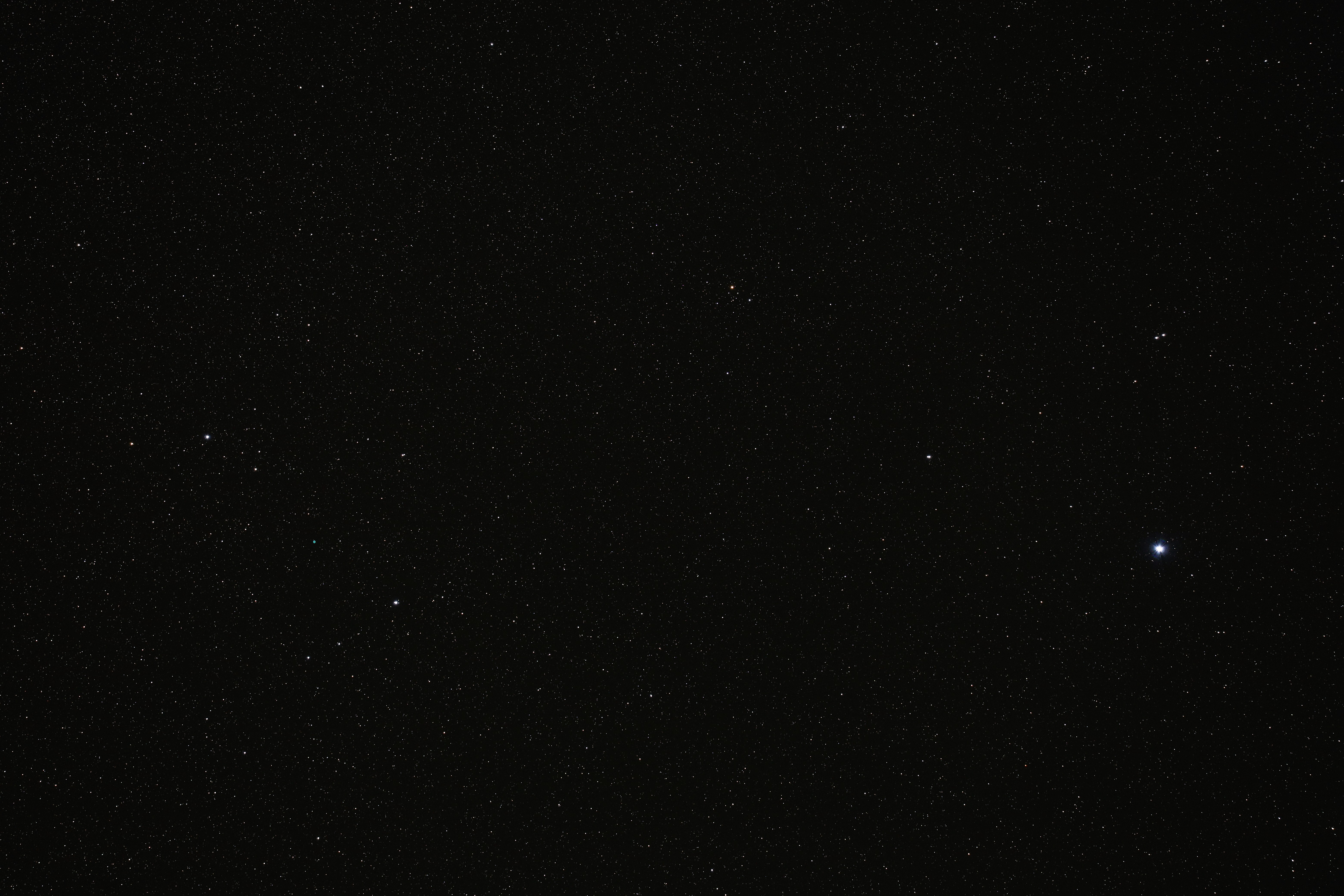
There haven't many clear nights this summer so far, but finally I had a chance to do some decent star-field shots to evaluate the quality of the RF 70-200mm for basic astro. First off I'm using a fairly basic AZ-GTi alt-az tracker and the exposures are all single shot, no image stacking. All shots are at max zoom 200mm with the camera in fully manual mode. Focusing at infinity is fairly smooth and for shots at high altitude (up to 80 degrees) there is absolutely no drift of the focus over time. The camera setting I use mostly is "Focus Bracketing" with 2 shots because the shutter is not activated so absolutely no vibration and in fully manual mode, the 2 shots are nice as often a satellite streak is only in 1 of the 2 shots. Occasionally I use "Long exp noise reduction" to remove hot pixel noise if it is too intrusive. Again twice as long but just one useful picture. Photos shot in Bortle 4.5. Tracking times in single shots for EOS-RP is limited to 30sec. Depending on where the shot is targeted in the sky, much longer exposure times are possible with minimal star trailing at edges of FOV.
The shots below are full frame and the star trailing is quite small at edges of FOV. Small aberrations are noticeable at edges but very acceptable for (according to others) arguably the best 70-200mm lens available. (I will compare this TP lens shots with a primary SBVONY SV555 240mm lens shortly). Full resolution shots are available at this website as well as more info on the shots:
Canon RF 70-200mm F2.8 L IS USM & Canon EOS RP