Turn on suggestions
Auto-suggest helps you quickly narrow down your search results by suggesting possible matches as you type.
- Canon Community
- Discussions & Help
- Gear Guide
- Re: 50-frame focus bracketing speed for EOS R5 or ...
Options
- Subscribe to RSS Feed
- Mark Topic as New
- Mark Topic as Read
- Float this Topic for Current User
- Bookmark
- Subscribe
- Mute
- Printer Friendly Page

Options
- Mark as New
- Bookmark
- Subscribe
- Mute
- Subscribe to RSS Feed
- Permalink
- Report Inappropriate Content
08-28-2025
03:02 PM
- last edited on
08-30-2025
08:10 AM
by
 Danny
Danny
I am looking for a camera system for outdoor macro photography and I think focus stacking (not too interested in-camera but using Zerene or Helicon) is essential nowadays. For a high success rate especially handheld but also on tripod a high frame rate is essential as it reduces the chance of movement (including wind). The best system in this respect is the OM-1 with its 90mm macro with almost 30 fps in bracketing mode but I don't like the colors and DR of the m4/3 cameras. All the FF cameras I tried were around 5fps so too slow for larger stacks. So I am looking for info about the bracketing speed (for instance how long for 50 frames in the bracketing mode). That will be likely also dependent on the lens used. I guess the main choice would be the RF100mm/2.8 except I am not excited about its weight and bulk.
Solved! Go to Solution.
2 ACCEPTED SOLUTIONS
Accepted Solutions


Options
- Mark as New
- Bookmark
- Subscribe
- Mute
- Subscribe to RSS Feed
- Permalink
- Report Inappropriate Content
08-31-2025 01:51 PM
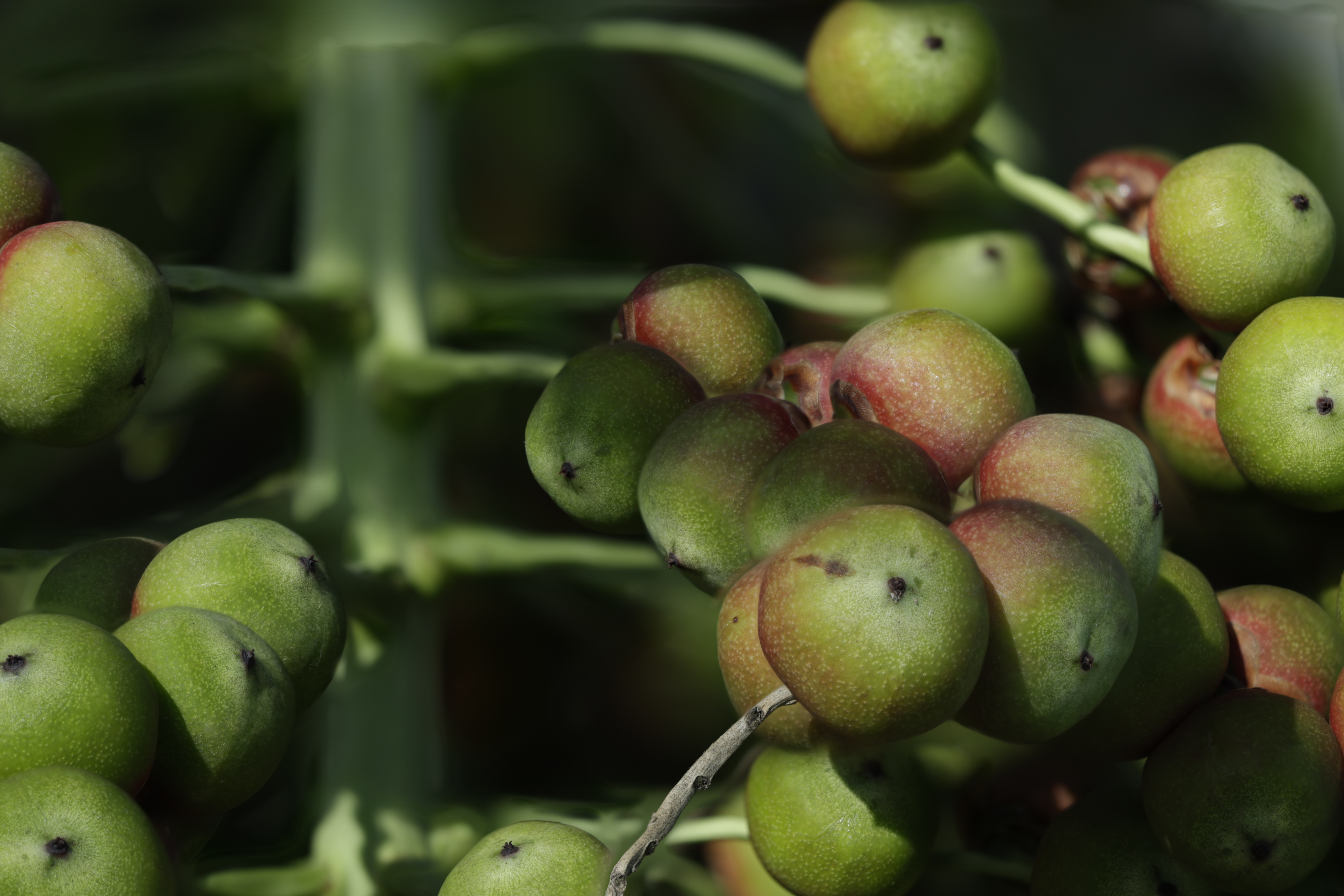
Hopefully this will get you closer to the answer you seek. It is by no means a "scientific answer," but rather a quick test I did. I used my R6 M2, RF 100mm 2.8 Macro lens, tripod and a stop watch. I set in camera focus bracketing for 120fps and took 5 sets of shots of some unripened Pindo Palm fruit (aka Jelly Palm).
Distance from front focal point (first berry) until the last one was 7.75 inches. Natural light, 2 second delay, ISO 200, shutter speed varied a bit (1/250 to 1/500s) as the light was changing (cloudy to bright), but I kept the aperture set at f/2.8 for all 5 sets. The results: 120fps @ 40fps setting = average of 3.12 seconds; factoring in perception / reaction time I'd say it was likely closer to 3 seconds.
I reviewed each of the 120 photos per set and at no time did the lens miss a shot, the shots progressed thru the entire sequence with each one moving the focal plane back in precise increments (a tribute to both he camera and the lens).
The enclosed photos are unprocessed and straight out of the camera (I shoot in RAW, the R6 M2 merges the stack in the camera and saves it in jpeg format)
Options
- Mark as New
- Bookmark
- Subscribe
- Mute
- Subscribe to RSS Feed
- Permalink
- Report Inappropriate Content
08-31-2025 08:57 PM
@jabo wrote:
That is quite difficult to have so many flowers behaving. If that sub sec means millisecond, 15 sec for each frame would be very impressive!
My guess is that it is 1/100 second for sub sec time original. About 150 milliseconds per frame, That was 8 frames in less than a second using EF16-35mm f/4L IS USM. I do not own a macro lens nor any RF lens. My point is that the time is recorded in meta data. The camera estimated focus distance of 0.43 meter for first frame and 0.7 meter for last frame. So far as I can remember, I used Canon DPP software to do the stacking for this one. I did not think that the other frames contributed anything useful, probably because at 24mm that lens changes composition as distance changes but i do not remember. For my camera, F/6.3 is the largest FNumber without small aperture diffraction blur.
10 REPLIES 10
Options
- Mark as New
- Bookmark
- Subscribe
- Mute
- Subscribe to RSS Feed
- Permalink
- Report Inappropriate Content
08-29-2025 09:06 PM - edited 08-29-2025 09:09 PM
Let me preclude this by saying I don’t own an R5 or R5 M2. The specs for them say they’ll shoot at 20 and 30fps respectively in high speed electronic shutter mode. So doing the math means at 30fps it would take 1.66 seconds to shoot 50 frames.
I have the R6 M2 which will shoot at 40fps in electronic shutter mode, so that translates to 1.25 seconds for 50 frames. I also have the RF 100mm f2.8 L Macro IS USM lens. I actually find the little bit of extra weight and bulk a good thing. For me I find it’s easier to hold it still as opposed to a lighter set up, such when I shoot with my Laowa 90mm f2.8 2x Ultra Macro APO (almost a pound lighter). As that’s a full manual lens you can either rock forward or rack the focus ring as you depress the shutter. This also works quite well for the RF 100mm in manual mode when using a 3rd party flash (I have the Godox V100 and the Godox MF-R76 Macro Ring Flash, at lower power settings they can easily keep up with the high frame rate of my camera).
Keep in mind that in camera focus bracketing only works with a select few canon flashes (the most expensive ones). Otherwise you will have to either use a continuous light source (LED panel or cube light) or shoot in manual where any good quality flash will work. Of course in camera focus bracketing also works if you have enough natural light and/or are a bit away from the subject, such as when shooting flowers.
Options
- Mark as New
- Bookmark
- Subscribe
- Mute
- Subscribe to RSS Feed
- Permalink
- Report Inappropriate Content
08-30-2025 12:45 AM
it is not too difficult to find the specs for high frame rate but that does not necessarily translate to the speed of focus bracketing as it also requires for the lens to change focus each step. So most of the time the fps for focus bracketing are slower than the burst rate (120 vs 30 fps for the OM1). So I am asking what would be that frame rate with the lens stepping (likely lens and camera dependent).

Options
- Mark as New
- Bookmark
- Subscribe
- Mute
- Subscribe to RSS Feed
- Permalink
- Report Inappropriate Content
08-30-2025 08:07 AM
https://cam.start.canon/en/H001/supplement_0010.html
Lenses and Flash Units Compatible with Focus Bracketing
The following lenses and flash units can be used when shooting with focus bracketing (as of March 2025).
Options
- Mark as New
- Bookmark
- Subscribe
- Mute
- Subscribe to RSS Feed
- Permalink
- Report Inappropriate Content
08-30-2025 10:18 AM
That is not explaining my question: speed of focus bracketing as that is essential for outdoor handheld or even on tripod.
Options
- Mark as New
- Bookmark
- Subscribe
- Mute
- Subscribe to RSS Feed
- Permalink
- Report Inappropriate Content
08-30-2025 11:09 AM
@jabo wrote:
That is not explaining my question: speed of focus bracketing as that is essential for outdoor handheld or even on tripod.
It is likely that I do not know the answers to your questions.
So far as I can guess, the reason those lenses are mentioned as good for baking a depth composite is that they focus in small steps and focus quickly. I had hoped it might answer the lens part of the question. I have used in camera depth composition with two of the EF lenses in the list using a tripod. If not using a tripod, I use hugin instead of DPP to combine the images. Hugin calls it focus stacking and is good at aligning images. DPP can stack the out of camera raw files if a tripod was used and the images are already aligned. 16 bit TIFFs saved from DPP are a good input for hugin.
I have only been able to make focus stacks in bright sunlight on one of the rare days here without wind.
Options
- Mark as New
- Bookmark
- Subscribe
- Mute
- Subscribe to RSS Feed
- Permalink
- Report Inappropriate Content
08-31-2025 01:51 PM
Hopefully this will get you closer to the answer you seek. It is by no means a "scientific answer," but rather a quick test I did. I used my R6 M2, RF 100mm 2.8 Macro lens, tripod and a stop watch. I set in camera focus bracketing for 120fps and took 5 sets of shots of some unripened Pindo Palm fruit (aka Jelly Palm).
Distance from front focal point (first berry) until the last one was 7.75 inches. Natural light, 2 second delay, ISO 200, shutter speed varied a bit (1/250 to 1/500s) as the light was changing (cloudy to bright), but I kept the aperture set at f/2.8 for all 5 sets. The results: 120fps @ 40fps setting = average of 3.12 seconds; factoring in perception / reaction time I'd say it was likely closer to 3 seconds.
I reviewed each of the 120 photos per set and at no time did the lens miss a shot, the shots progressed thru the entire sequence with each one moving the focal plane back in precise increments (a tribute to both he camera and the lens).
The enclosed photos are unprocessed and straight out of the camera (I shoot in RAW, the R6 M2 merges the stack in the camera and saves it in jpeg format)
Options
- Mark as New
- Bookmark
- Subscribe
- Mute
- Subscribe to RSS Feed
- Permalink
- Report Inappropriate Content
08-31-2025 03:06 PM
Thanks Jeff for that info. 120frames in around 3 sec is much faster than any FF camera of other brands can do with in camera focus bracketing. I assume that was with electronic shutter. So the R6m2 is likely better for that purpose than the R5M2. I am curious what the specs will be of the R6M3 which likely have a small increase to 30Mpx which would allow a little more cropping.
Looking at the in camera stacks I see some Halo artifacts (quite similar to the OM-1 II) but using Zerene or Helicon that will likely not be an issue.
With 40fps a quality LED light will be better than searching for flashes which can keep up
Options
- Mark as New
- Bookmark
- Subscribe
- Mute
- Subscribe to RSS Feed
- Permalink
- Report Inappropriate Content
08-31-2025 03:14 PM
If the camera saved all of the raw files as well as the composite, exiftool may be used to list the time for each photo including subsecond time.
exiftool -h -datetimeoriginal -SubSecTimeOriginal ../2024Jun02/IMG_00[01][0-9].CR3
| File Name | IMG_0011.CR3 |
| Date/Time Original | 2024:05:27 09:55:34 |
| Sub Sec Time Original | 40 |
| File Name | IMG_0012.CR3 |
| Date/Time Original | 2024:05:27 09:55:34 |
| Sub Sec Time Original | 55 |
| File Name | IMG_0013.CR3 |
| Date/Time Original | 2024:05:27 09:55:34 |
| Sub Sec Time Original | 70 |
| File Name | IMG_0014.CR3 |
| Date/Time Original | 2024:05:27 09:55:34 |
| Sub Sec Time Original | 85 |
| File Name | IMG_0015.CR3 |
| Date/Time Original | 2024:05:27 09:55:34 |
| Sub Sec Time Original | 99 |
| File Name | IMG_0016.CR3 |
| Date/Time Original | 2024:05:27 09:55:35 |
| Sub Sec Time Original | 14 |
While I am not especially skilled at this and some of these flowers moved, here is an example:
https://www.rsok.com/~jrm/2024Jun02_birds_and_cats/2024may27_wildflower_IMG_0009-0016c.html

Options
- Mark as New
- Bookmark
- Subscribe
- Mute
- Subscribe to RSS Feed
- Permalink
- Report Inappropriate Content
08-31-2025 07:53 PM
That is quite difficult to have so many flowers behaving. If that sub sec means millisecond, 15 sec for each frame would be very impressive!


Announcements
07/22/2026: New firmware updates are available.
EOS R6 Mark III - Version 1.1.0
05/13/2026: New firmware updates are available.
EOS R5 Mark II - Version 1.3.0
EOS R6 Mark II - Version 1.7.0
04/28/2026: Service Notice: Caution Concerning use of Lithium Batteries
03/17/2026: New firmware updates are available.
SELPHY CP1500 - Version 1.0.7.0
02/23/2026: New firmware update is available for EOS C50- Version 1.0.3.1
01/23/2026: New firmware update is available for RF 24-105mm F4 IS USM- Version 2.0.7
01/20/2026: New firmware updates are available.
10/21/2025: Service Notice: To Users of the Compact Digital Camera PowerShot V1
10/15/2025: New firmware updates are available.
Speedlite EL-5 - Version 1.2.0
Speedlite EL-1 - Version 1.1.0
Speedlite Transmitter ST-E10 - Version 1.2.0
07/28/2025: Notice of Free Repair Service for the Mirrorless Camera EOS R50 (Black)
05/21/2025: New firmware update available for EOS C500 Mark II - Version 1.1.5.1
Related Content
- Struggling with HDR: Edit highlights and shadows in RAW image before merging in DPP4? in Camera Software
- PIXMA TS4320 - Won't interface with phone in Printer Software & Networking
- General All purpose Lens for moving kids indoors and outdoors in Gear Guide
- EOS R5 C no RAW-Video in Professional Video
- R6 Mark II WiFi Connectivity Issues when pushing to SFTP in EOS DSLR & Mirrorless Cameras


Ⓒ 2026
Canon U.S.A Inc. All Rights Reserved. Reproduction in whole or part without permission is prohibited.
